
Development Finance: ground-up and major projects, funded properly
From single new-builds to multi-unit schemes: how development funding is structured (land + build costs), what lenders fund, and how the money actually flows.
Talk to Ashley about your scheme
Development finance funds the construction of property, and it differs from every other kind of lending in one fundamental way: the asset you are borrowing against does not exist yet. The lender advances money against something you are going to build, releases it in stages as you build it, and gets repaid when you sell or refinance.
That single fact drives everything else. The staged drawdowns, the monitoring surveyor, the experience requirements, the personal guarantees, the contingency. None of it is bureaucracy. It is all a response to the problem that a half-built scheme is worth considerably less than either the site you started with or the houses you are going to finish.
Thirty nine of the 67 short-term lenders we track (our wider panel runs to over 120 lenders across all product types) offer development finance, 25 offer development exit, and only four offer mezzanine. This page explains how a facility is sized, how the money actually arrives, what it really costs, and where development finance stops and bridging begins.
The three tests, and which one actually binds
Every development facility is sized against three numbers. Understanding how they interact is the difference between a realistic expectation and a wasted month.
GDV, gross development value. What the finished scheme is worth. Normally the aggregate of the individual unit values, assessed by the lender's valuer, not by you and not by your agent.
LTC, loan to cost. The facility as a percentage of total project cost, meaning the land or site purchase, the build cost, professional fees, and usually finance costs. It measures how much of the project the lender is funding and how much of your own money is in it.
LTGDV, loan to gross development value. The total facility as a percentage of the finished value. It measures the lender's exposure against the end product.
Both tests apply. The lower result governs. You do not get to pick.
"Most of the disappointment in development finance comes from a developer running one test and the lender running two. You work out 90% of your costs, you get a number you like, and then the valuation comes in and the other test takes over. Run both from the start and nothing surprises you."
What the market actually offers
Across our index the two tests have drifted a long way apart:
| Test | Range published | Median |
|---|---|---|
| Loan to cost | 60% to 100% | 90% |
| Loan to gross development value | 60% to 100% | 70% |
Of the lenders that publish a maximum loan to cost, 26 are at 90% or above, which is more than half of them. On the other test, 23 publish a loan to gross development value of exactly 70% and twelve offer 75%.
That asymmetry is the whole story. The market has become generous on cost and stayed conservative on end value. Stretched senior facilities at 90% of cost are mainstream now rather than exotic, and that is largely what has absorbed the mezzanine layer that used to sit above senior debt.
The crossover: a rule worth knowing
Because both tests apply and the lower governs, there is a precise point at which one takes over from the other. It depends on nothing except the ratio of your total cost to your GDV.
With a lender offering 90% of cost and 70% of GDV, the two tests give the same answer when total cost is 77.8% of GDV. Below that, the cost test binds. Above it, the GDV test binds.
| Lender's tests | Cost-to-GDV crossover |
|---|---|
| 90% LTC / 70% LTGDV | 77.8% |
| 90% LTC / 75% LTGDV | 83.3% |
| 85% LTC / 70% LTGDV | 82.4% |
| 80% LTC / 70% LTGDV | 87.5% |
| 90% LTC / 65% LTGDV | 72.2% |
| 100% LTC / 70% LTGDV | 70.0% |
The practical version: a profitable scheme is limited by the cost test, and a thin scheme is limited by the GDV test. If your total cost is comfortably under about three quarters of your GDV, how much of your own money you put in is what decides the facility. If your costs are creeping towards 80% of GDV, the end value decides it, and no amount of additional equity will unlock more borrowing.
Knowing which side of that line you are on tells you where to spend your effort. On the equity, or on the scheme.
A worked scheme
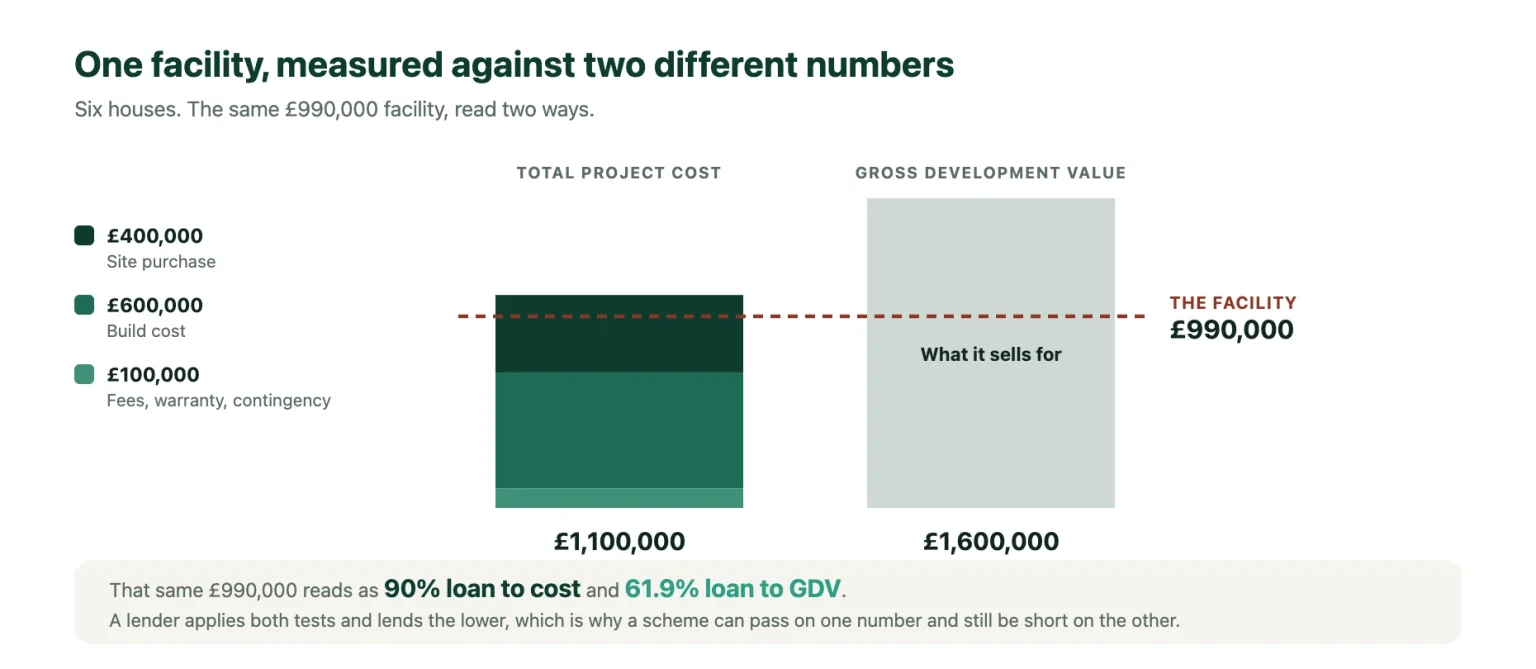
Six houses on a small site.
| Site purchase | £400,000 |
| Build cost | £600,000 |
| Professional fees, warranty, contingency | £100,000 |
| Total project cost | £1,100,000 |
| Gross development value | £1,600,000 |
Against a lender offering 90% of cost and 70% of GDV:
| 90% of £1,100,000 cost | £990,000 |
| 70% of £1,600,000 GDV | £1,120,000 |
| Lower figure governs, so the facility is | £990,000 |
| Developer equity required | £110,000 |
Cost here is 68.8% of GDV, comfortably below the 77.8% crossover, so the cost test binds and the developer needs 10% of total cost in cash.
Now change the GDV and watch what happens
| GDV | Cost as % of GDV | Facility | Which test binds | Your equity |
|---|---|---|---|---|
| £1,600,000 | 68.8% | £990,000 | Cost | £110,000 |
| £1,450,000 | 75.9% | £990,000 | Cost | £110,000 |
| £1,350,000 | 81.5% | £945,000 | GDV | £155,000 |
A £250,000 fall in GDV, which is a valuer's opinion rather than anything you did, increases the cash you have to find by £45,000. Nothing about the build changed.
Two things follow from that. Sensitivity test your scheme against a GDV 10% below your expectation before you commit, because that is the range within which valuers reasonably disagree. And get the GDV evidenced from comparable sales rather than from a yield calculation on assumed rents, because on a development facility the GDV is not an aspiration, it is a constraint.
The day one advance is not the whole facility
The £990,000 above is the total. It does not arrive at once, and the gap between those two ideas catches people out constantly.
On day one the lender advances against the site, typically 50% to 65% of the land value or purchase price, whichever is lower. The rest is the build facility, released in stages.
In our worked scheme, a day one advance of 65% of the £400,000 site is £260,000 against a total facility of £990,000. So on completion day the developer needs the £140,000 balance of the land price, plus stamp duty, plus fees, out of their own resources. The £110,000 equity figure is not the day one cash requirement, and the two get confused constantly.
Where a developer already owns the site, some lenders will advance against its current value with planning, which can release equity and reduce the day one cash requirement to nothing. Others will not. A few will fund both land purchase and construction costs.
How the money actually arrives: staged drawdowns
The build facility is released in arrears, against work completed and certified. The cycle is always the same:
- You complete a stage of work and pay for it
- You submit a drawdown request with supporting invoices or valuations
- The lender instructs the monitoring surveyor
- The surveyor inspects and reports on the value of work properly completed
- The lender releases funds against the certified figure
Each cycle takes two to three weeks in practice, and the variable is almost always the surveyor's availability rather than the lender's decision.
Drawdown frequency is usually monthly, sometimes against defined stages: foundations, superstructure, roof, first fix, second fix, completion. Most lenders set a minimum drawdown value and a maximum number of releases. At least one lender has no rules on minimum or maximum drawdowns at all, lets developers deal with the monitoring surveyor directly, and makes no internal charge for reviewing the request. That is unusual and it genuinely saves both money and weeks. Staged drawdown finance is worth reading alongside this if the release mechanics are what concern you.
Three things that catch developers out
Funds are released against work done, not invoices raised. A builder who has invoiced for work not yet completed will not be funded. Some lenders will release against materials on site, which eases cash flow considerably. Ask, because it is rarely volunteered.
The surveyor certifies value, not your claim. If you claim £80,000 of work and the surveyor assesses £65,000, you get £65,000. Disputes cost a further inspection and a further fortnight.
You fund each stage before you are reimbursed. This is a working capital requirement that sits entirely separate from your equity, and it is the most common reason schemes stall. On monthly drawdowns of £60,000 with a three week cycle, you need roughly £60,000 of working capital available continuously, not once.
The monitoring surveyor
Also called a project monitor, an asset manager or a quantity surveyor depending on the lender. They act for the lender. You pay for them.
What they do. An initial report before the first drawdown, reviewing the scheme, the costings, the programme, the contractor, the planning and the warranty, and confirming the build cost is realistic. Then an interim inspection before each drawdown, certifying work completed to date.
What it costs. The initial report is the expensive one, commonly £1,000 to £3,000 on a modest scheme and more on anything complex, because it involves desk review as well as a site visit. Interim inspections are cheaper, typically £400 to £900 each. One lender publishes a fixed scale for works up to £500,000 at £415 plus VAT for the initial report and £258 plus VAT per interim, which is at the low end and applies to refurbishment rather than ground-up work.
On an eighteen month scheme with twelve drawdowns, that puts monitoring somewhere between £6,000 and £14,000. It is a real line in the cost plan and it is routinely left out of developers' appraisals.
How to reduce it. Fewer, larger drawdowns. Accurate claims that do not require a second visit. And check whether your lender charges an internal review fee on top of the surveyor's, because some do and some explicitly do not.
Interest roll-up, and what it really costs
This is the most commonly misunderstood thing about development finance, and for once the misunderstanding runs in the developer's favour.
Interest is charged on the drawn balance, not on the facility. You are not paying for £990,000 from day one. You are paying for £260,000 in month one, rising as the build draws down. Interest is rolled up and added to the balance rather than paid monthly, so there is nothing to service.
Take our worked scheme. A £990,000 facility, £260,000 drawn on day one against the land, the remaining £730,000 drawn evenly over fifteen months of build, and three further months to sell, at a headline 0.85% per month.
| Average drawn balance over the term | £706,000 |
| Interest actually charged over 18 months | £108,035 |
| Interest if charged on the full facility | £151,470 |
| Difference | £43,435, or 29% less |
So the interest comes to 10.9% of the facility over eighteen months. Eighteen months at the headline rate on the full facility would have been 15.3%. That gap is the point. These figures are calculated on a simple basis, and where a lender compounds the rolled-up interest monthly the real number sits a little above them.
Three consequences follow:
The headline rate overstates the cost substantially. Comparing a development rate to a bridging rate as though they were equivalent is wrong, because a bridge is usually charged on the full facility from day one and a development facility is not.
Drawing early costs you. Every month a tranche sits drawn is a month of interest. Drawing in advance of need, or front-loading the programme, is expensive.
Delay is expensive twice over. Interest keeps accruing once the build is finished, and the balance is at its highest precisely when the scheme is complete and unsold. Three months of sales delay on our scheme at the full £990,000 costs around £25,000.
One thing to ask about: some lenders charge a non-utilisation fee on the undrawn portion, with one charging 0.30% per month on tranched loans. That materially changes the arithmetic above, and it is not always offered up.
What lenders want from you
Development lending is as much about the borrower as the scheme.
Experience. The single biggest factor. Most lenders want to see completed schemes of comparable size and type, usually two or more. First time developers are not excluded, and several lenders fund them, but expect lower leverage, a higher rate, and a requirement for an experienced contractor or project manager alongside you. Some cap first timers to small schemes: one funds up to £1m GDV, which gives up to four houses or six flats.
Personal guarantees. Standard. Typically from all directors or shareholders above a threshold, commonly 20% or 25%. Many lenders cap the guarantee at a percentage of the facility rather than the whole, and that percentage is negotiable. A debenture over the borrowing company is usual too.
The contractor and the build contract. The lender will assess the contractor's experience, accounts and insurance. A fixed price contract with a named contractor is strongly preferred. A JCT or similar standard form is better received than a letter of intent. Where the developer is also the contractor, expect additional scrutiny and sometimes a requirement to appoint an independent project manager.
Contingency. Expect to include 10% to 15% of build cost, sometimes 20% on a conversion or refurbishment where unknowns are likelier. Critically, not every lender funds the contingency. We have seen a lender fund an £80,000 build budget while specifically excluding the 15% contingency, which meant the developer had to find £12,000 themselves on top of everything else. Ask explicitly whether contingency sits inside or outside the funded cost.
A full information pack. One lender's published requirements give a representative list: signed term sheet, application form, certified identity and address, an assets and liabilities statement, a credit search within the last 30 days, planning permission and approved drawings, building regulations sign-off or interim certificates, a full schedule of works, contractor details, an acceptable structural warranty, and initial and interim asset manager inspections.
An evidenced GDV, from comparable sales rather than assumptions, and a realistic programme, because the term is set by it and extending costs.
Planning
Most development lenders require full, detailed planning permission in place before they will lend. Outline permission with reserved matters outstanding is a different proposition: some lenders will consider it at reduced leverage, many will not, because the scheme that eventually gets consented may not be the one that was appraised.
A minority will lend before planning at all, generally at low leverage against land value and on the basis that the site works without consent. At least one lender states plainly that planning is not required, which is unusual.
Where you are buying a site and intend to obtain planning, that is normally a bridging transaction rather than a development facility, refinanced onto development finance once consent is granted. Our pre-planning finance page covers that route in detail, including what lenders will and will not take planning risk on.
Building regulations are treated differently from planning. Planning is usually a condition precedent, required before completion. Building regulations are handled during the build, with interim certificates accepted at drawdown stages and final sign-off required before redemption.
The exit
Development finance is repaid in one of two ways, and the lender will test whichever you propose.
Sale of the completed units. The lender will want evidence of demand, a realistic absorption rate, and comparable sales supporting the GDV. Most facilities permit partial redemptions as units sell, with a release price per unit agreed at the outset. That release price is worth negotiating, because one set too high means early sales do not reduce the debt enough to keep the facility within covenant.
Refinance onto a term product. Where the scheme is being held rather than sold, the exit is usually a buy to let or commercial investment mortgage. The lender will want to see that the rent will cover the term lender's stress test, and will often ask for an agreement in principle.
Where development exit bridging comes in. Development facilities are expensive relative to a bridge, and they often expire before the last unit sells. A development exit bridge refinances a completed or near-complete scheme onto cheaper money, buying time to sell without the pressure of an expiring facility. Pricing starts well below senior development rates, with one lender quoting from 0.45% per month over base and another from 0.69%. Twenty five of the 67 lenders we track offer it. The common condition is that the scheme must be finished or nearly so, with one lender requiring less than 10% of construction costs to remain. Our development exit page covers the criteria, timing and pricing.
Where development finance stops and bridging starts
This boundary matters, because the products price and behave differently and the wrong one costs you both time and leverage.
It is a bridge, not development finance, when:
- The existing building is retained and you are improving it rather than building. One lender's published test is that at least one existing wall must remain
- The work is refurbishment, however heavy, rather than construction
- No new units are being created from nothing
- The scheme does not need a structural warranty
It is development finance when:
- You are building from the ground up, or demolishing and rebuilding
- The scheme requires a structural warranty
- The build is funded in stages against cost rather than against a works schedule
- Construction, rather than improvement, is the substance of what you are doing
The overlap is real and it is wide. A heavy refurbishment bridge with staged drawdowns and a monitoring surveyor looks very like a small development facility, and on a conversion of a building into flats the two products genuinely compete.
| Heavy refurb bridge | Development facility | |
|---|---|---|
| Sized against | Current value plus works, capped by LTGDV | Cost and GDV together |
| Day one advance | 70% to 75% of purchase price | 50% to 65% of land value |
| Typical LTGDV | 70% to 75% | 65% to 70% |
| Typical LTC | Often unstated | 80% to 90% |
| Term | 9 to 18 months | 12 to 36 months |
| Monitoring | Sometimes | Always |
| Warranty | Rarely | Usually |
On a conversion, run both. A heavy refurbishment product frequently gives a better day one advance and a simpler process, while a development facility usually gives a larger total facility against cost.
The funding stack
A development scheme is funded in layers, and the order matters because each layer has a different price and a different claim on the asset.
Senior debt is the first charge facility covering most of the cost. It is what the rest of this page describes. Pricing is commonly quoted as a margin over base rate, with published examples from around 4.70% over Bank of England base and 5.50% over base, or as a monthly rate from around 0.56% plus base. Our senior debt page goes into the structure in more detail.
Stretched senior is the same first charge facility taken to a higher loan to cost, commonly 85% to 90%, sometimes with a condition attached. One lender offers 85% of cost rising to 90% where the developer puts in 5% cash. With 26 lenders now at 90% or above, this layer has largely replaced the need for mezzanine on ordinary schemes.
Mezzanine sits behind the senior lender as a second charge, filling the gap between what senior will lend and what the developer can fund. It is expensive, commonly 15% to 20% a year, with one provider on our index quoting from 20% per annum and lending to 75% of end value combined, or 80% on a super mezzanine product, with loan to cost at 90% or 95%. Only four lenders on our index offer it. The binding constraint on mezzanine is rarely the mezzanine lender; it is the senior lender's consent and the intercreditor deed, plus any negative pledge in the senior facility agreement. Our mezzanine page covers that in detail.
Joint venture equity replaces debt with a profit share rather than interest. It solves a cash problem that debt cannot, and it costs a share of the upside. Our JV page covers when it makes sense.
The developer's own equity sits last and is repaid last.
"Raising equity mid-build makes your loan to cost worse, not better. If you pull cash out while the debt stays the same or rises, your own stake falls and every lender in the stack sees a weaker position. It is a common instinct when cash gets tight, and it is usually the wrong move."
Costs beyond the interest
- Arrangement fee, typically 1% to 2% of the facility, sometimes charged on the full facility rather than the drawn amount
- Exit fee, commonly 1%, and sometimes calculated on GDV rather than on the loan, which is considerably more expensive
- Monitoring surveyor, as above
- Valuation, including an initial GDV valuation and sometimes interim revaluations
- Legal costs, both sides, higher than on a bridge because the documentation is heavier
- Non-utilisation fee on the undrawn balance with some lenders
- Structural warranty premium
- Extension fees where the scheme overruns, which it frequently does
Development Finance Solutions from Bridging Finance Broker
How much of my own money do I need for development finance?
On a 90% loan to cost facility, 10% of total project cost, provided the GDV test does not bite first. Remember the day one cash requirement is different and usually larger, because the initial advance covers only part of the land.
Which matters more, loan to cost or loan to GDV?
Whichever produces the lower facility. With a typical 90% cost and 70% GDV lender, the cost test binds while your total cost is under about 78% of GDV, and the GDV test binds above that.
Can I get 100% development finance?
Against the scheme alone, no. One lender on our index publishes up to 100% of cost, and arrangements marketed as 100% generally involve additional security, a joint venture profit share, or both. If you own another property with equity, a higher effective leverage is achievable.
Do I need planning permission first?
For most development lenders, full detailed permission, yes. Outline is harder and a minority will lend pre-planning at low leverage. Buying a site in order to obtain planning is normally a bridging transaction.
Will I need to give a personal guarantee?
Almost certainly, from all significant shareholders, usually alongside a company debenture. The amount is often capped at a proportion of the facility and that cap is negotiable.
Can a first time developer get development finance?
Yes, from a number of lenders, at lower leverage and usually with a requirement for an experienced contractor or project manager. Some restrict first timers to small schemes.
How long does a drawdown take?
Two to three weeks from request to funds, with the monitoring surveyor's availability usually the constraint. Budget working capital for one full stage.
What happens if the build overruns the term?
Extensions are available with a fee and a fresh assessment, and interest continues on the full drawn balance, which is at its peak at that point. Building a realistic programme with contingency at the outset is far cheaper than extending.
What if the build costs more than budgeted?
The contingency is the first line, which is why lenders require it. Beyond that, a facility increase is a new credit decision and depends entirely on whether there is headroom against the GDV test. If you were already at the cap, there is none.
What is the difference between development finance and a development exit bridge?
Development finance funds the build. A development exit bridge refinances a finished or nearly finished scheme onto cheaper money while the units sell, typically requiring less than 10% of construction costs to remain.
Is interest charged on the whole facility?
No. Interest accrues on the drawn balance only, and is normally rolled up rather than serviced monthly. On a typical eighteen month scheme that makes the real interest cost roughly a third less than the headline rate applied to the full facility would suggest.
Related
Got a deal like this on your desk?
Tell us the numbers and we'll tell you honestly what's achievable.
Prefer to put it in writing? Email support@bridgingfinancebroker.co.uk