
Auction Bridging Finance: funding agreed before you bid
28 days from hammer to completion. We arrange finance that moves at auction speed, ideally agreed in principle before you raise your hand.
Talk to Ashley about your deal
Auction bridging finance is short-term lending built to complete inside the deadline an auction contract gives you. When the hammer falls on an unconditional lot you are legally committed, and most auction houses want the balance in 28 days. A residential or buy-to-let mortgage will not usually move that fast. A bridging loan will, and that is the whole reason this product exists.
What follows is how it actually works. How much you can borrow, what it costs, how the deadline gets met, and the things that decide whether a deal funds or falls over. It comes from the lending criteria of the 67 short-term lenders we track (our wider panel runs to over 120 lenders across all product types), 47 of which currently do an auction product.
Why an auction purchase needs different funding
At a traditional auction the contract is binding when the hammer falls. You pay the deposit that day, normally 10% of the hammer price, and you have exchanged contracts there and then. Completion is usually 28 days later.
That 28 days is the problem. Inside it you have to fit a valuation, the lender's legal work, your solicitor reading the legal pack, searches or search insurance, and the money actually moving. A mainstream mortgage rarely gets from application to completion in that time. And if the lender misses the date, the lender does not carry the consequences. You do.
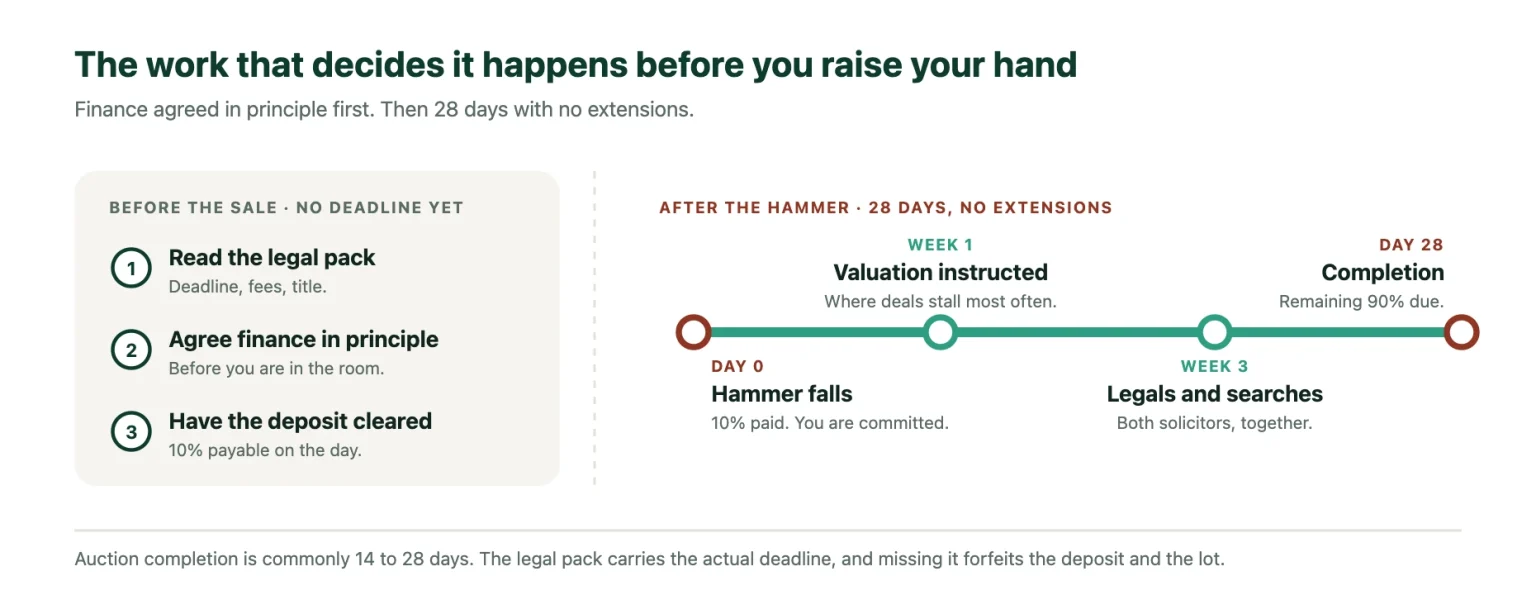
Miss completion and you lose the deposit. You are also still liable under the contract, and if the property is remarketed for less, the seller can come after you for the shortfall and their costs. So the exposure is not capped at the 10%. That is why certainty of funding matters more at auction than anywhere else in property, and why the useful conversation happens before the auction rather than after the hammer.
Short-term lenders are built around this timescale. Indicative terms, valuation, legals and drawdown all run on a different clock to a high street mortgage.
"If you have never bought at auction, go to one and do not bid. Sit at the back, watch how it runs, talk to the auctioneer afterwards. Then when you do come back to bid you are making a decision instead of reacting to one."
Traditional and modern method auctions are not the same thing
Your timescale depends on which type of auction you are in, and first-time bidders often do not realise there are two.
Traditional, or unconditional. Contracts exchange at the fall of the hammer. 10% deposit on the day, completion normally 28 days later. No cooling-off period, nothing subject to survey, nothing subject to finance. This is what most commercial and investment auction houses run.
Modern method, or conditional. Your bid gets accepted and you pay a non-refundable reservation fee instead of exchanging. You then have a window to exchange, and completion usually lands 56 days after your solicitor receives the draft contract.
The practical difference is that a conditional sale can often be done with a normal mortgage, and an unconditional lot usually cannot. But do not read conditional as safe. The reservation fee sits on top of the purchase price rather than coming off it, you are not protected from being gazumped because neither side is committed until exchange, and the clock does not start until somebody else sends a contract to your solicitor. There is a longer comparison in our post on why the modern method is not the easy option.
Guide price, reserve price, and the costs on top
The guide price is a marketing number. It is not a valuation and it is not what the lot will sell for. The reserve is the lowest the seller will take, it stays confidential between seller and auctioneer, and it is commonly set as much as 10% above the guide. Either figure can be moved before the sale.
Then there are the costs that sit on top of the hammer price, and these are the ones people forget to budget for:
- A buyer's premium or administration fee, charged on some lots and added to the price
- The seller's legal costs and the searches pack, where the special conditions push them onto the buyer
- Arrears of ground rent or service charge on a leasehold lot
- Stamp duty, which gets its own section below
None of that is normally lendable. It comes out of your own cash, and it needs working out before you bid rather than discovering afterwards.
How much can you borrow on an auction property?
Headline loan to value across the short-term market runs from about 65% to 80%, and 75% is the most common maximum. Across the lenders we track the median maximum is 75%, and roughly three quarters will look at 75% or above on a standard residential investment property.
That is where the answer starts, not where it ends. Three rules decide what you actually get.
One: the lender works from the lower of price and valuation
This is close to universal, and it is the most misunderstood point in auction finance.
Buy a house for £150,000 that values at £200,000 and the loan is worked out on £150,000. The £50,000 of equity is yours, but you cannot borrow against it on day one. Some lenders will refinance against the higher figure after a period of ownership, commonly six months, but that is a second transaction with its own fees.
It cuts the other way too. Bid £200,000, have the valuation come back at £180,000, and the advance is calculated on £180,000 while your cash requirement goes up by the difference. At auction you are already committed when that happens. Which is the real reason experienced bidders decide their maximum before the sale and then stop. If we have agreed terms at £285,000 and you bid £305,000, the finance no longer matches the purchase.
Two: gross and net are different numbers, and the gap is big
A gross loan to value is the size of the facility. The arrangement fee, and on most auction loans the whole of the interest for the term, come out of it before anything reaches your solicitor. A net loan to value is the money that actually arrives.
On a £200,000 purchase with a 75% facility, a 2% arrangement fee and twelve months of retained interest:
| Quoted gross | Quoted net | |
|---|---|---|
| Purchase price | £200,000 | £200,000 |
| Facility at 75% | £150,000 gross | £150,000 advanced |
| Arrangement fee | deducted | added to the facility |
| Retained interest | deducted | added to the facility |
| Reaches your solicitor | about £131,700 | £150,000 |
| Cash you have to find | about £68,300 | £50,000 |
Same 75% headline, £18,300 difference in what you need on the day. A minority of lenders quote net, where the percentage you are offered is the money in hand, and a lower net figure often beats a higher gross one.
So ask one question of any quote: what reaches the solicitor on completion. If the answer is a percentage rather than a cash figure, you cannot compare it to anything yet.
Three: above 75% needs a real discount, and auction prices rarely give you one
Products advertising 80% or 90% almost always run two tests at the same time. Up to a high percentage of the purchase price, commonly 85% or 90%, but never more than a lower percentage of open market value, commonly 70% or 75%. Whichever gives the smaller number is the one that applies.
Take a £150,000 purchase where the lender offers 90% of price or 70% of market value:
- 90% of £150,000 is £135,000
- For £135,000 to also be 70% of market value, the property has to be worth £192,857
- That is a discount of about 22% on what you paid
At a 75% market value test it needs to be worth £180,000, so a 17% discount. Those are big margins, and here is the bit specific to auctions: a competitive public sale is generally treated as establishing market value. The hammer price is what a willing buyer paid in open competition on the day, and most valuers will report it that way.
Which brings up something worth saying plainly. Buying under market value at auction is not the same thing as a below market value transaction. Genuine below market value deals do exist, but they tend to come from off-market, distressed, probate or related-party situations rather than from an auction room. Treat an advertised 90% as a product for a narrow set of cases. Plan your cash on 70% to 75% gross and you will not get caught.
Minimum loan sizes and minimum property values
Small lots fail on size more often than anything else. Of the lenders we track with a published minimum, roughly two thirds will not go below £100,000 and about a third will not go below £250,000. At the other end, a handful will consider loans from £20,000 to £30,000.
Minimum property value is a separate gate, and often a stricter one. Some lenders will not take security on anything valued below £75,000. Others set it at £100,000, and some will not look at a property under £250,000 no matter how big the loan is. A cheap lot in a low-value area can be unfundable even for a strong borrower with a big deposit. Worth establishing before you register to bid.
What auction bridging finance costs
Rates
Monthly rates broadly run from around 0.55% to 1% a month on a first charge against standard residential property, with the bottom of that range going to lower loan to value tiers, straightforward security and experienced borrowers. From there:
| What changes it | Effect |
|---|---|
| Loan to value | The main driver. Between a 65% and a 75% tier with the same lender, commonly 0.05% to 0.10% a month |
| Semi-commercial and commercial security | Prices higher, typically from around 0.85% to 1.2% a month |
| Heavy refurbishment | Above light refurbishment, often by 0.15% to 0.20% a month |
| Second charge | Prices above a first charge, and maximum loan to value drops to around 65% or 70% gross |
| Foreign national and expat | Carries a premium with most lenders who offer it |
| Regulated | Sometimes above the equivalent unregulated loan, occasionally below. Do not assume either way |
These are monthly rates, not annual, because the terms are short. 0.85% a month is not 0.85% a year. Over twelve months it is a little over 10% of the balance before fees, and that is the number to hold in your head when you are working out whether a deal carries its finance costs.
How the interest gets charged
Three ways, and the choice changes your cash position.
Retained is the default on auction finance. The lender works out the interest for the whole term and holds it back from the advance at the start, so you make no monthly payments. The cost is a smaller net advance, as the table above shows. Most lenders rebate what you do not use if you redeem early, usually daily after a minimum period of one to three months, so a loan repaid in month five of a twelve-month term normally attracts about five months of interest. Get the rebate basis and the minimum period in writing, because they vary.
Serviced means you pay it monthly out of income. It protects your net advance, but you need provable income to cover the payments, and on an empty auction property there is no rent yet.
Rolled adds the interest to the balance each month instead of taking it up front. Fewer short-term lenders offer it and it tends to sit on longer facilities.
The other fees
- Arrangement fee, typically 1.5% to 2% of the gross facility, deducted from the advance
- Exit fee, charged by some lenders and not others. Where it applies it is often around 1%, and watch whether it is calculated on the gross facility or the balance outstanding, because the first is more expensive than it looks
- Valuation fee, paid up front, varying with value and property type
- The lender's legal costs, which you pay, plus your own solicitor
- Commitment or application fee, taken by some lenders at full application before the valuation and searches are instructed. That is money at risk before you have an offer
- Extension fees, commonly from 1% of the balance, and more where the extension was not agreed in advance
- Default and arrears charges, including monthly arrears fees and the cost of recovery action
Ask for the full tariff of fees at the start of every case. The rate and the arrangement fee are the two numbers that get quoted. The tariff is where the rest of the cost lives.
Stamp duty on an auction purchase
Stamp duty is payable on the hammer price and it is not lendable. For England and Northern Ireland:
Standard residential rates are nil up to £125,000, then 2% to £250,000, 5% to £925,000, 10% to £1.5 million and 12% above that.
The higher rates for additional dwellings add 5 percentage points to every band, so 5%, 7%, 10%, 15% and 17%. That surcharge went from 3% to 5% on 31 October 2024. It applies if you already own another dwelling anywhere in the world, and to essentially every company purchase of a dwelling. Most auction investment purchases land in it.
On a £200,000 investment purchase that is £11,500 of stamp duty. The same property bought as your only home would be £1,500.
Two more things that catch auction buyers:
Companies buying dwellings over £500,000 face a flat 17%, also from 31 October 2024, unless a relief applies. Relief is there for property held in a rental business, and for developers and traders, each with conditions. Most ordinary investment purchases qualify, but it has to be claimed properly.
Multiple dwellings relief was abolished on 1 June 2024. Buying a block of flats on one title no longer gets relief for the number of dwellings, which changed the economics of multi-unit auction lots quite a lot. Some guidance still floating around has not caught up.
Non-UK residents pay another 2 percentage points on top of everything else. Scotland and Wales run their own systems with their own bands and surcharges. Any of this can change at a Budget, so check the current position before you commit, and take advice on your own circumstances.
Funding the refurbishment as well as the purchase
A lot of auction stock needs work, and that is often why it is at auction in the first place. Most lenders split refurbishment two ways, and which side of the line you are on changes both the product and the price.
Light refurbishment is non-structural, usually defined as costing less than 25% of the property value. Kitchens, bathrooms, decorating, windows, flooring, modernising.
Heavy refurbishment is structural work, or work costing more than 25% of value, or anything needing planning permission or building regulations approval. Extensions, loft conversions, moving walls about, structural repair, full rewires and replumbs, splitting one house into flats.
Fewer lenders do heavy, the pricing is higher, and they will usually want a schedule of works, costings, and sometimes a monitoring surveyor or quantity surveyor.
The works money comes in arrears, and this catches people out
Where a lender funds the refurbishment, the money is almost always released behind the work rather than in front of it. You pay for a stage, the lender's surveyor inspects and signs it off, then you get reimbursed. Each inspection costs money and adds days.
So there is a working capital requirement that has nothing to do with your deposit. A project with £40,000 of works does not need £40,000 on day one, but it does need enough cash to fund the first stage and to cover every gap between paying a builder and being paid back. Budgeting the deposit and assuming the works money turns up at completion is one of the more common ways a refurbishment runs out of money halfway through.
Where works are funded the lender also caps total borrowing against the end value, commonly 70% or 75% of gross development value, and sometimes against total cost as well. On a modest refurbishment with a decent uplift, the day one advance against purchase price is usually the binding number. Where the works are large relative to the purchase, the end value cap becomes the one that decides the deal, and then the end value has to be properly evidenced rather than estimated.
One more practical thing. You know your completion date the moment the hammer falls, so book your trades against it. Good builders are quoting months out, and a refurbishment that cannot start for twelve weeks is twelve weeks of interest on a loan that was meant to be short.
Regulated or unregulated?
This narrows the field more sharply than any other single thing.
A bridging loan is regulated by the Financial Conduct Authority where it is secured on a property you, or an immediate family member, live in or intend to live in. It is unregulated where the security is an investment property, a commercial property, or a limited company purchase for investment.
Most auction finance is unregulated, because most auction buyers are investors. But if you are buying at auction to live in it, the loan is regulated, and of the lenders we track only 12 offer regulated bridging at all. That panel is smaller, minimum property values are often higher, maximum loan to values are typically lower, and there are advice and disclosure requirements that take time.
So buying your own home at auction is harder to finance than buying an investment, which is the opposite of what most people assume. It has to be arranged before you bid, not after.
What lenders actually look at
Short-term lenders underwrite the asset and the exit far harder than they underwrite your income. Roughly in order of importance:
The exit. How the loan gets repaid is the first question and it decides most cases. Two normal routes: refinance onto a longer-term mortgage, usually buy to let, or sell. The lender will test whether it is realistic. Will the rent cover a buy-to-let stress test. Will the property be mortgageable once the work is done. Is the sale price assumption supportable. Is the timescale achievable. A loan with a vague exit does not get offered however good the security is.
The security. Type, condition, location, tenure, title, marketability. Everyone is really asking whether it could be sold if the exit fails.
Experience. A lot of lenders tier their maximum advance by track record. It is common for a first-time borrower to be capped well below the headline, with the top tier kept for people who can evidence two or more completed projects of a similar type. The gap between tiers can be several percentage points of loan to value, which on a mid-sized purchase is tens of thousands of pounds of cash. Find out early, because it changes what you can afford to bid.
Credit history. Far more tolerant than mainstream lending. A clear majority of the lenders we track will consider some adverse credit on an underwriting basis, and several do not credit score at all. Adverse does not usually stop a deal, but it can move the pricing and narrow the panel.
Your overall position. Assets, liabilities, and where the deposit came from. Lenders increasingly want to see the funds behind the part of the purchase they are not lending.
Property types that narrow the field
Auction catalogues are full of exactly the stock mainstream lenders decline, which is why short-term finance exists. These are the ones that shorten the panel, and every one of them is fundable by somebody:
- Listed buildings, particularly Grade II. Most short-term lenders will consider them, a minority will not, and automated valuations are generally off the table
- Short leases, where minimum unexpired term requirements vary a lot. A very short lease may need the loan structured around a statutory extension
- Japanese knotweed, where policy is rarely published and has to be asked case by case, usually needing a treatment plan with an insurance-backed guarantee
- Non-standard construction, including concrete, timber frame, steel frame and prefabs
- Properties with no kitchen or bathroom, or otherwise uninhabitable, which fail most mainstream criteria and are ordinary business here
- HMOs and multi-unit freehold blocks. Widely accepted, though some lenders cap the number of units and some exclude large HMOs
- Ex-local authority flats, particularly in taller blocks or where private ownership in the block is low
- Mixed use and semi-commercial, where maximum loan to value typically drops to around 70%
- Structural movement, fire damage, or a history of subsidence
- Land, with or without planning, which is a different product with much lower loan to values
Geography matters too. A clear majority of short-term lenders cover England and Wales. Around half will lend in Scotland, where the legal system and conveyancing process are different. Only a small minority lend in Northern Ireland, and a handful apply postcode restrictions or avoid remote areas.
How to actually hit the 28 days
The deadline gets met by sequencing, not by speed on its own.
Arrange the finance before you bid. Terms in principle before the auction, with the lender knowing the specific lot and the deadline, is the difference between a comfortable completion and a scramble. Bidding first and sorting finance afterwards is how deposits get lost.
Get the legal pack read before the sale. With an estate agent purchase no legal work has been done at all. At auction the pack is sitting there waiting for you, and it is the best free due diligence you will ever get. Title, searches, leases, tenancies, EPC, and the special conditions. The special conditions are where the surprises live: transferred seller's costs, obligations with deadlines, restrictive covenants, missing title guarantees, overage, rights of way. A 50-year lease is the reason a flat looks like a bargain and will not be mortgageable when you come to exit. A solicitor reading the pack after the hammer is reading it too late.
Use a solicitor who has done auction work. There is no room in 28 days for a learning curve, and an auction completion runs differently from a normal purchase.
Ask about dual representation. One firm acting for both you and the lender removes an entire layer of letters going back and forth, and it is the single biggest time saver available on a tight deadline. Some lenders offer it as standard, some refuse it on principle. Ask before you choose the lender.
Get the valuation instructed the same day. Valuation turnaround is usually the longest single item in the chain. Where a desktop or automated valuation is acceptable it removes days, but it depends on the property being straightforward. And understand the trade: if you want the maximum the market will lend you, you will need a physical valuation. You cannot have maximum leverage and maximum speed at the same time.
Budget for search insurance. Full local authority searches can take longer than the completion window. Indemnity insurance is commonly used instead and most short-term lenders accept it, but confirm it with the specific lender rather than assuming.
Know what you will do if the valuation comes in low. This is the most common reason an auction completion gets into trouble. A contingency, whether that is extra cash, a second charge somewhere else or an alternative lender, is what turns a problem into an inconvenience.
Term, exit, and the six month rule
Terms typically run 3 to 24 months, with 12 months the most common on an auction purchase. Across the lenders we track the median maximum is 24 months, and a small number go considerably longer where the exit justifies it.
There is normally no penalty for repaying early, and most lenders rebate unused retained interest daily after a short minimum period. So there is little reason to take a shorter term than you might need. Taking twelve months when the project needs six costs very little if the rebate basis is good, and it removes the risk of paying 1% of the balance for an extension.
Start the exit before you need it. A buy-to-let refinance takes time, needs the property habitable and let or lettable, and some buy-to-let lenders apply a minimum ownership period of six months before they will lend at all, or will only lend against your original purchase price inside that window. That six month rule is a frequent reason bridging loans need extending, and it is completely predictable from day one.
Why auction deals fall through
Failed auction completions cluster around a short list of causes, and almost all of them are foreseeable:
- The valuation came in below the hammer price and there was no contingency for the shortfall
- The cash requirement was worked out on a gross loan to value, with no allowance for the fee and retained interest coming out
- Stamp duty, the buyer's premium and the transferred seller's costs were not budgeted
- The property or the loan falls below a lender's minimum value or minimum loan size
- The legal pack contained a condition nobody read before bidding
- The title is defective, the lease is too short, or a consent or guarantee is missing
- The exit does not stand up, most often a rent that will not cover a buy-to-let stress test
- The loan was regulated and got approached as though it was not
- Documents arrived late. Assets and liabilities, CV, bank statements, cost of works. Every day those take is a day off the 28
- Somebody bid past the number their terms were agreed at
- The works budget covered the deposit but not the working capital needed while tranches come back in arrears
Every one of those is answerable before you raise your hand in the room. That is the practical argument for getting auction finance arranged in advance rather than treating it as something to sort out inside the 28 days.
Won at £285,000 against a £235,000 guide, and completed inside the 28 days.
Read the full case study →Understanding Auction Finance Costs at Bridging Finance Broker
How quickly can auction bridging finance complete?
Fast enough for a 28 day deadline, and usually with room to spare if the case is packaged properly. What sets the pace is not the lender's credit decision, it is the valuation and the legal work. Get those instructed on day one and the rest follows.
Can I get finance agreed before the auction?
Yes, and you should. Terms in principle cost nothing and they make your bidding ceiling real instead of hopeful. Get them at your maximum bid, not at the guide price, because terms at the guide are worthless the moment somebody bids past it.
Can I get 100% of the purchase price?
Not against the property on its own. Products described as 100% finance are secured against additional property as well, so the total borrowing still sits inside a normal loan to value across the combined security. If you have a second property with enough unencumbered equity it is achievable. Otherwise you need a deposit.
Can I use another property as additional security?
Yes, and it is a common way to cut or remove the cash deposit. Check the arithmetic though, because a second charge behind an existing mortgage usually tops out around 65% to 70% of value on a gross basis. A property worth £170,000 with £100,000 already owed may release very little once the fee and interest come out of what is left. Additional security helps most where the property is unencumbered or lightly mortgaged.
Do I need a deposit on the day of the auction?
Yes. A traditional auction wants 10% of the hammer price on the day, out of your own funds. Bridging finance pays the balance at completion, not the deposit. On a £285,000 lot that is £28,500 there and then.
What happens if I cannot complete in 28 days?
Speak to the auctioneer and your solicitor straight away. Some sellers will give a short extension, usually at a cost and sometimes with interest on the outstanding balance. If you get no extension you can lose the deposit and still be liable under the contract, including the seller's costs and any shortfall if the lot is resold for less. If a £285,000 property goes back under the hammer and makes £270,000, that £15,000 can come back to you on top of the deposit you have already lost.
Is 28 days calendar days or working days?
Ask the auction house rather than assuming, because the difference is a fortnight of your timetable. While you are asking, check the auction house fee and who pays it, and read the terms for the actual completion date. Small questions, large consequences, one phone call.
Is auction finance more expensive than a normal mortgage?
Yes, substantially, on a monthly basis. That is the correct trade. It buys you speed and it funds property a mainstream lender will not touch. The question is not whether the rate is higher than a mortgage rate. It is whether the deal carries the finance cost over the months you actually need it, and what your alternative was.
Can I borrow for the refurbishment as well as the purchase?
Many lenders will fund the works alongside the purchase, in some cases the full cost of them. The money comes in tranches behind the work rather than up front, so you need working capital to fund each stage before you are reimbursed. The total is also capped against the end value of the project.
Can you get a mortgage on an auction property?
Sometimes, but rarely inside 28 days, and plenty of auction stock will not pass a mortgage valuation anyway. Bridging buys you the time to fix the property and then refinance onto a mortgage.
Do I need to be an experienced investor?
No, but experience changes the terms. First-time borrowers are accepted by a clear majority of short-term lenders. What experience affects is the maximum advance, with the higher tiers often kept for people who can evidence completed projects of a similar type. If this is your first auction property, plan on the lower tier.
Does bad credit stop me borrowing?
Usually not. Short-term lenders underwrite the asset and the exit rather than leaning on a credit score, and most will look at adverse credit case by case. It can affect pricing and narrow the choice of lender, but it is rarely the reason a sensible auction deal does not fund.
What if the property is unmortgageable?
That is normal at auction and it is exactly what bridging is for. The lender looks at the end value and your exit, not whether a high street lender would touch it today.
Related
Got a deal like this on your desk?
Tell us the numbers and we'll tell you honestly what's achievable.
Prefer to put it in writing? Email support@bridgingfinancebroker.co.uk