
Refurbishment Bridging Loans: fund the works, then exit well
Light refurb finance for projects that add value: buy, improve, then sell or refinance onto a better product. Includes what counts as "light" versus "heavy", the line that changes everything.
Talk to Ashley about your deal
Refurbishment bridging finance funds the purchase of a property and the work needed to improve it, then repays when the property is refinanced onto a mortgage or sold. It is the engine behind most buy, refurbish, refinance projects, and it is the single most common reason investors use short-term lending.
Of the 67 short-term lenders we track (our wider panel runs to over 120 lenders across all product types), 56 offer a light refurbishment product and 46 offer heavy refurbishment. That gap of ten lenders is the first clue to something this market handles badly. Light and heavy refurbishment are not industry terms with agreed meanings. They are product names, and every lender draws the line somewhere different.
So this page explains where the line actually sits, what it costs you to be on the wrong side of it, and how light refurbishment works in practice. Heavy refurbishment has its own page covering drawdowns, monitoring and planning.
Where light stops and heavy starts
Ask ten lenders and you will get materially different answers. Here is what they actually publish, and what their underwriters actually apply.
The planning permission test. One lender draws the line precisely where planning permission begins. Light refurbishment covers anything under permitted development and anything needing only building regulation sign-off: replacement windows, decoration, heating and electrical work, reconfiguration, full rewires, new kitchens and bathrooms, and conversion to an HMO of up to six tenants. Heavy is any conversion needing planning permission, large HMOs and multi-unit blocks. That is the cleanest definition published anywhere and it is also the most workable, because planning is a binary fact rather than a judgement.
The percentage of value test. This is the one most people quote, and it varies far more than anyone admits:
- One lender caps works at 25% of open market value on its light product, confirmed by its business development manager
- Another applies 20% on semi-commercial security
- A third funds light refurbishment with build costs up to 40% of day one open market value, and heavy with build costs up to 100%
- A fourth allows a works budget of up to 50% of current value across its refurbishment range
So the "25% rule" that circulates as though it were a standard is one lender's figure. Across the market the real range on light refurbishment runs from 20% to 50% of value, and on heavy up to 100%.
The structural test. A lot of lenders use structural against non-structural as the dividing line. Anything touching load-bearing elements, anything involving extensions or loft conversions, anything changing the number of units. That sounds simple and usually is, but it leaves ambiguity around things like removing one internal wall with a beam, which some lenders treat as light and others do not.
The floor area test. One lender permits structural works including loft and single-storey extensions where the floor area increases by up to 33%, and publishes no other definition at all. That 33% is their entire test.
The drawdown test. One lender defines its light product by mechanics rather than by the works. Light means one works drawdown and no monitoring surveyor. Anything needing staged releases and inspections is a different product.
The one wall test. At the top end, the line that matters is between heavy refurbishment and ground-up development finance. One lender requires at least one existing wall to be retained for a scheme to qualify as refurbishment. Demolish everything and it is development, which is a different product at a different price.
And some lenders use three tiers rather than two: light, medium and heavy, each a step up in rate.
"The same scheme can be light at one lender and heavy at another. That is not an anomaly, it is how the market is built. My job is to find the lender whose definition fits your scheme, not to argue your scheme into a category."
The honest working definition
There is no universal rule, so use this as a practical test rather than a definition.
It is probably light if the work is cosmetic or non-structural, it falls under permitted development or needs only building regulations, it costs less than around a quarter of the property's current value, and the footprint and the unit count stay the same.
It is probably heavy if it is structural, it needs planning permission, it changes the number of units, it extends the building, it converts the use, or it costs more than a quarter to a third of current value.
Assume nothing and confirm it in writing.
What the classification actually costs you
Being classified heavy rather than light costs less on rate than people fear, and more on everything else than they expect.
On rate, the gap is narrower than you think. Across lenders publishing both, the differential typically runs 0.10% to 0.20% a month. One lender prices light at 0.70% and heavy at 0.85%. Another runs light at 0.89%, medium at 0.98% and heavy at 0.99%. A third shows 0.69% and 0.79% on light tiers against 0.79% and 0.89% on heavy.
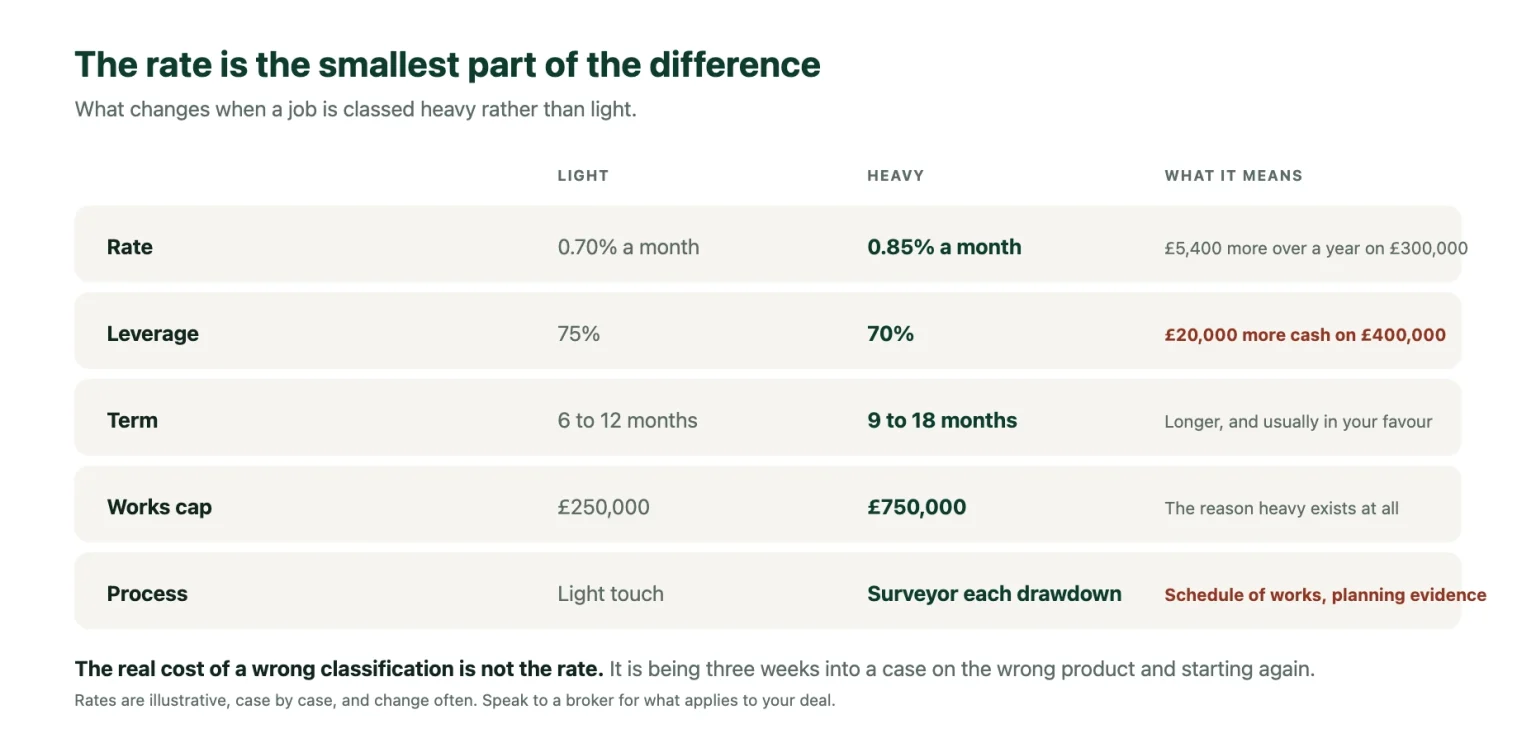
On a £300,000 facility over twelve months, 0.15% a month is £5,400. Real money, but not usually the thing that decides a project.
On leverage, the gap bites harder. One lender offers 75% on standard and light refurbishment but drops heavy to 70% of current market value. Another keeps the headline at 80% net on both, but the versions with drawdowns fall to 75% net, and the maximum loan to gross development value drops from 75% on light to 70% on heavy. Five percentage points of leverage on a £400,000 project is £20,000 of cash you have to find.
On term, heavy is longer, and that is usually a good thing. One lender runs light at 6 to 12 months and heavy at 9 to 18. A longer minimum term sounds like a cost, but most refurbishment projects overrun, and a facility that ends before the work does is far more expensive than a slightly higher rate.
On works caps, the difference is large. The same lender caps works at £250,000 on light and £750,000 on heavy.
On process, heavy costs time. Monitoring surveyor inspections before each drawdown, a schedule of works, contractor details, planning evidence, and sometimes a structural warranty. Each of those is days.
The real cost of a wrong classification is not the rate. It is being three weeks into a case with the wrong product and having to start again.
The reclassification problem
There is a practice in this market worth naming plainly, because it causes more trouble than any other single thing on a refurbishment case.
A borrower with a scheme that is obviously heavy presents it as light, because the light product is cheaper, quicker and needs less paperwork. The schedule of works describes a kitchen, a bathroom, decoration and "some internal alterations". The internal alterations are a wall coming out, a loft going in and the house becoming a six-bed HMO.
It frequently gets through the initial underwrite, because at application stage the lender is working from a description. And here is the part that surprises people: the valuer often does not catch it either. A valuer attending a vacant property is instructed to value it in its current condition and, on a refurbishment case, in its proposed condition against a schedule of works. They are valuing, not auditing. If the schedule says light works and the property is empty, there is frequently nothing on site to contradict it.
So the loan completes. And then one of several things happens.
- The monitoring surveyor arrives and the scheme is not what was described. On a light product with no monitoring, this surfaces at the exit valuation instead, which is later and worse
- Building control or planning enforcement gets involved, because the work needed consent that was never obtained. The lender now has security with an unauthorised alteration and a borrower who cannot sell or refinance it
- The works budget runs out, because a budget written for a light scheme does not fund a heavy one. This is the most common outcome, and it arrives at roughly the halfway point
- The exit fails. A buy to let lender's valuer attends a property that has been structurally altered without consent, or converted to an HMO without a licence, and declines. The bridge now has no exit, and the borrower is looking at an extension at 1% of the balance while they retrospectively obtain consents that may not be granted
- The facility agreement is breached. Most agreements require the borrower to carry out the works described and to obtain all necessary consents. Doing materially different work is an event of default, whatever the valuer did or did not notice, and default interest and recovery charges follow
Getting a cheaper product by describing the scheme inaccurately is not a saving. It is a deferred problem with interest on it. Price the scheme honestly, find the lender whose definition fits, and accept the 0.15% if it is genuinely heavy. The alternative costs multiples of that.
And if a scheme is genuinely borderline, say so at the outset. Underwriters deal with borderline schemes constantly and will usually tell you which side of their line it falls on in a phone call.
Light refurbishment in practice
What counts
Non-structural work that improves a property without changing what it is. Replacement kitchens and bathrooms, rewiring, replumbing, new heating systems, replacement windows and doors, re-roofing, plastering, flooring, decoration, garden works, damp proofing, and internal reconfiguration that does not touch load-bearing elements. Several lenders also treat conversion to a small HMO as light where it falls under permitted development, with one specifying up to six tenants.
How much you can borrow
Day one advances on light refurbishment typically run to 70% to 75% gross of the purchase price, with a small number of lenders reaching 80% and at least one publishing 80% net, which is a materially different and better proposition because the headline is the money in hand.
And remember the lower of purchase price and valuation rule. On a purchase the lender advances against whichever is lower, so buying below market value does not increase your day one money.
Is 100% of works really available?
Yes, genuinely, and more widely than on heavy refurbishment. But it is always capped, and the cap is where people get caught.
The caps that apply in practice:
- A percentage of current value. One lender funds 100% of works but caps build costs at 40% of day one open market value. A £40,000 budget on a £150,000 property is 27% and passes. A £70,000 budget on the same property is 47% and does not
- A maximum loan to gross development value, commonly 70% to 75%. On a modest refurbishment with decent uplift this rarely binds. On a scheme where the works are large relative to the purchase price, it becomes the figure that decides everything
- A maximum day one loan to value across the whole facility. One lender funds up to 100% of light refurbishment costs subject to a maximum 85% day one loan to value
- A minimum loan size. One lender's 100% of works product has a £500,000 minimum, which rules out most light refurbishment entirely
- A cash works cap, such as £250,000 on light products at one lender and £100,000 on a specialist EPC uplift product
So "100% of works" is real, but read it as "100% of works, up to a cap set by the value of the property". Establish which cap binds on your scheme before you commit to a budget.
Money up front, or in drawdowns?
This is the most practical question on a light refurbishment, and the answer is usually drawdowns, with one important exception.
Most lenders release works money in arrears. You pay for a stage, the lender's surveyor or asset manager inspects, the lender reimburses. On light refurbishment this is often lighter touch than on heavy, with some lenders capping the number of releases: one allows a maximum of four drawdowns, another permits five, and a third defines its light product as a single works drawdown with no monitoring at all.
A single drawdown at the end is the most common light refurbishment structure, and it is the one to aim for on a small scheme. You fund the works, the lender inspects once when they are finished, and releases the money as a lump sum. Fewer inspections, lower fees, less delay.
Very few lenders release works money in advance. Where it happens it is usually on a small, defined scheme with an experienced borrower, and it will cost you in rate or leverage.
What this means for your cash. A £40,000 works budget does not need £40,000 on day one, but it does need enough to fund the first stage and to bridge the gap between paying a builder and being reimbursed. Each cycle is typically two to three weeks from invoice to money in your account. Budget for one full stage of works as working capital, separate from your deposit. Running out of cash halfway through is the single most common way a light refurbishment gets into trouble, and it is entirely predictable.
The most common light refurbishment budget mistake
It is not underestimating the build cost, although that happens too. It is budgeting for the works and forgetting the holding costs.
A light refurbishment budget usually captures materials and labour. What gets left out:
- Finance costs during the void. Interest runs from drawdown, not from when the work starts
- Council tax on an empty property, frequently at a premium rate
- Vacant property insurance, which is more expensive than standard cover and carries inspection conditions
- Utilities standing charges throughout
- The gap between practical completion and refinance, which is routinely six to ten weeks once you allow for the valuation, the application and the legal work
- Stamp duty, including the 5% additional dwellings surcharge, which is not lendable
- The second defect. Opening up a property with one known problem reveals another more often than not
The second most common mistake is refurbishing to the wrong standard. If the exit is a refinance, you are refurbishing to pass a valuer, who is asking whether the property is habitable, safe and saleable. If the exit is a sale, you are refurbishing for a buyer, which is a different and more expensive specification. Decide the exit first, because it sets the budget. There is more on that on our page about properties a mortgage lender will not touch.
Add 15% to 20% contingency. Lenders prefer to see it, and projects consume it.
How long to allow
Everyone says three months and takes six.
| Stage | Realistic |
|---|---|
| Completion to works starting | 1 to 3 weeks |
| The works themselves | 6 to 12 weeks |
| Snagging and making good | 1 to 3 weeks |
| Exit valuation and refinance | 6 to 10 weeks |
| Total, completion to redemption | 4 to 7 months |
The works are rarely the problem. The problems are the gap before they start, because contractors book up, and the gap after they finish, because a refinance takes longer than people allow and some lenders apply a six month ownership rule before they will lend against the improved value.
Take twelve months, not six. Most lenders have no early repayment charge and rebate unused retained interest, commonly daily after a minimum period of one to three months. Redeeming a twelve month facility in month six typically costs around six months of interest. Taking six months to look efficient, then needing an extension at 1% of the balance plus a fresh assessment, costs considerably more. Our rates page sets out how the rebates work.
When refurbishment finance is the wrong product
When the works are cosmetic and the property is already mortgageable. A standard buy to let mortgage plus savings is far cheaper than a bridge. Refurbishment bridging earns its cost when the property will not currently mortgage, or when speed is the point.
When you are demolishing and rebuilding. That is development finance, which funds the build in stages and prices for it. One lender's test for whether a scheme is still refurbishment is whether at least one existing wall is retained.
When there is no uplift. If the finished value does not comfortably exceed the purchase price plus the works plus the finance costs plus the stamp duty, the project does not work, and no amount of structuring fixes that.
When the exit depends on a planning decision that has not been made. Some lenders take planning risk. Most do not, and those who do price it.
Your questions
What is the difference between light and heavy refurbishment?
There is no universal definition. Broadly, light is non-structural work under permitted development that does not change the property's footprint or unit count, and heavy is structural work, extensions, conversions, or anything needing planning permission. The thresholds vary by lender from 20% of value to 100%, and one lender uses planning permission as its only test. Our heavy refurbishment page covers that side in detail.
Can I get 100% of the refurbishment costs?
Often yes, but always subject to a cap. Typically a percentage of the property's value, a maximum loan to gross development value, or a cash limit. Establish which cap binds on your scheme before you set the budget.
Do I get the works money up front?
Usually not. It is released in arrears against completed and inspected stages. On a small light refurbishment a single release at the end is common. Budget working capital for at least one full stage.
How much deposit do I need for a refurbishment bridge?
Typically 25% to 30% of the purchase price in cash on a gross facility, plus stamp duty, plus working capital for the works, plus fees. On a net basis the deposit is lower, which is why the gross or net question matters more than the headline percentage.
Do I need planning permission in place?
For light refurbishment, usually not, because the work falls under permitted development. For heavy refurbishment many lenders require planning to be in place on day one and will not fund a scheme awaiting a decision.
Will I need a monitoring surveyor?
On light refurbishment often not, particularly with a single drawdown. On staged releases, and on heavy refurbishment, yes.
How soon can I refinance after a refurbishment?
As soon as the property is lendable and the works are signed off, subject to the ownership rule many lenders apply, which commonly requires six months before they will lend against the improved value. A meaningful number of lenders do not apply it, which is worth establishing before you draw down rather than after.
What if the works cost more than budgeted?
The overrun is yours to fund in the first instance. Some lenders will consider increasing the facility if the end value supports it and the loan to gross development value still works, but it is a new credit decision, not an automatic top-up.
Can I live in the property during the works?
If you or a close family member occupies it or intends to, the loan is regulated, and only 12 of the 67 lenders we track offer regulated bridging. It is possible, but the panel is a fraction of the size and it has to be arranged that way from the start.
What counts as light refurbishment work?
Kitchens, bathrooms, rewiring, replumbing, heating, windows and doors, re-roofing, plastering, flooring, decoration, damp proofing, garden works, and internal reconfiguration that does not touch anything load-bearing. Several lenders also allow conversion to a small HMO where it falls under permitted development.
Is a refurbishment bridge more expensive than a normal bridge?
Light refurbishment prices close to standard bridging. Heavy prices 0.10% to 0.20% a month above light. The bigger difference is leverage and process rather than rate.
Related
Got a deal like this on your desk?
Tell us the numbers and we'll tell you honestly what's achievable.
Prefer to put it in writing? Email support@bridgingfinancebroker.co.uk