
Below Market Value Bridging: finance against what it is worth
Bought well? The right lenders will work from the property's true market value rather than the discounted price you negotiated. That can mean putting in far less cash, sometimes covering most of the purchase price. Here is how BMV bridging genuinely works.
Talk to Ashley about your deal
Below market value bridging is one of the most misunderstood products in short-term lending, and the misunderstanding is always the same. People assume that buying a property for less than it is worth means a lender will advance against what it is worth. In nearly every case, it will not.
So this page explains the difference between buying cheaply and a genuine below market value transaction, what a lender needs before it will work from valuation rather than price, what has to be true to reach 90% of the purchase price, and how to tell a real BMV opportunity from a listing that just says BMV.
The default rule: lenders use the lower of price and valuation
Start here, because it governs everything else.
Almost every short-term lender calculates the loan against the lower of the purchase price and the valuation. Buy a property for £200,000 that values at £260,000 and the loan is a percentage of £200,000, not £260,000. One lender puts it in their criteria in terms: the net loan is divided by the lower of purchase price and valuation, so there is no below market value stretch on a purchase at all.
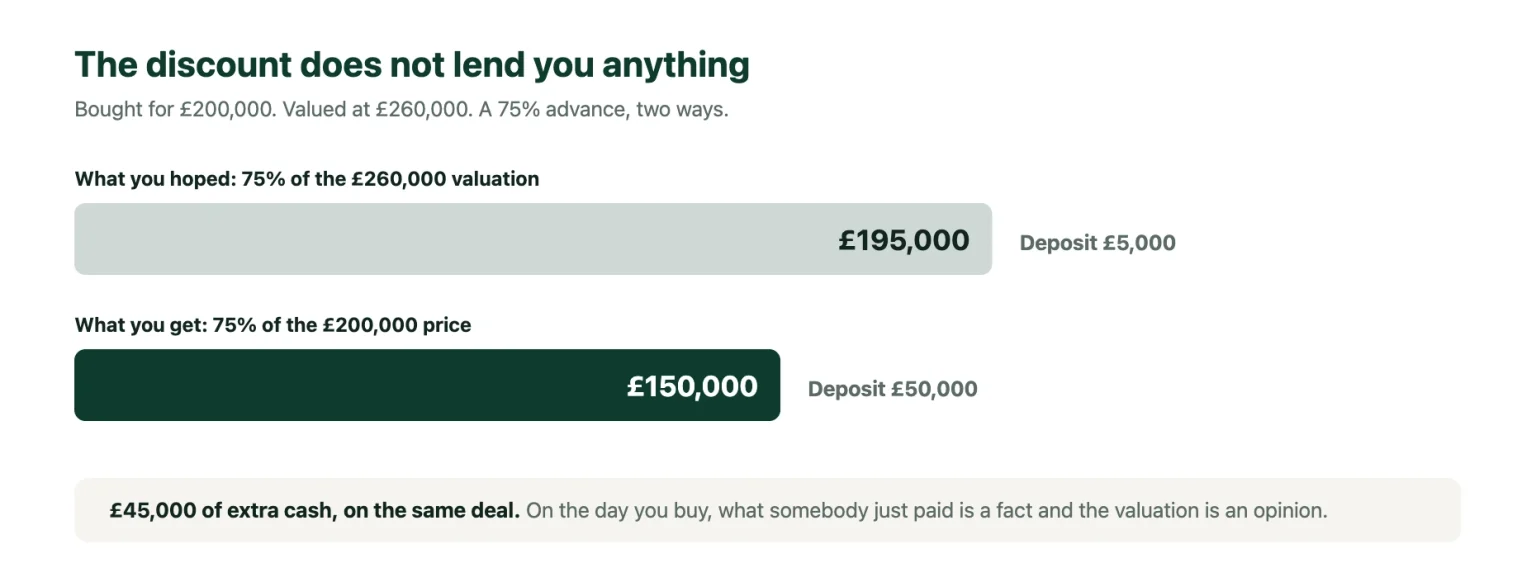
This is not lenders being awkward. The reasoning is straightforward. On the day you buy, the best evidence of what a property is worth is what somebody just paid for it in an arm's length transaction. A valuer's opinion that it is worth more is an opinion. A completed sale is a fact.
We have seen this applied on a live case: a lender working to market value equals purchase price on a below market purchase, with the valuer reporting the price as the value.
So the default position is that a discount benefits you, but not on day one. The equity is real and it is yours. You simply cannot borrow against it immediately.
"The test a lender applies is not did you buy cheaply. It is why did this seller accept less, and can you prove it. If the only answer is that you negotiated well, the price is the value and that is the end of it."
Buying under market value versus a genuine BMV transaction
This distinction is the whole page, and it is where most of the confusion sits.
Buying under market value means you negotiated well, or you bought at auction below what the property might fetch after refurbishment, or the seller priced it keenly. This is ordinary good buying. It happens constantly. It does not change how a lender calculates the loan.
A genuine below market value transaction is one where there is an identifiable, evidenced reason the seller accepted less than the property is worth, and that reason has nothing to do with the property's condition or the state of the market. The classic reasons:
- A seller who needs certainty or speed more than price. A genuine distressed sale, a relocation deadline, a broken chain the seller cannot afford to lose
- A related party transaction, such as a family member selling to another at an agreed undervalue, or a landlord selling to a sitting tenant
- An inheritance or probate situation where beneficiaries want a clean, quick division rather than the best price
- A gifted equity purchase, where the seller's discount is explicitly documented as a gift
- A corporate or portfolio disposal where a block price produces an undervalue on individual units
- A repossession or receivership sale, where the seller has a duty to achieve market value but is selling under time pressure
Where there is no explanation other than good negotiating, the lender will treat the price as the value, and it will be right to.
When will a lender work from valuation rather than price?
Some will, and this is what they want.
A clear, documented reason for the discount. Usually a seller's declaration or a solicitor's confirmation explaining the circumstances. Gifted equity needs a gifted equity letter. A related party sale needs the relationship disclosed. A distressed sale needs the distress to be real and evidenced.
An arm's length transaction, or a properly disclosed non arm's length one. Lenders are alert to arrangements designed to extract cash at completion. What they are guarding against is a price inflated or deflated by agreement between the parties to produce a larger advance.
A valuation that independently supports the higher figure. Not the agent's view, not your comparables, but the lender's own valuer concluding that market value exceeds the price. On an open market sale, and particularly at auction, valuers will usually say the price is the value, because a competitive sale is the strongest evidence of market value there is.
Full disclosure of everything affecting the price. Vendor deposits, cashbacks, incentives, deferred payments, and any side agreement. These must be disclosed, and several lenders refuse vendor deposits outright. One caps builder incentives at 5%. Non-disclosure here is mortgage fraud, not a technicality.
Experience, frequently. One lender restricts its BMV product to experienced landlords only, defined as three buy to let purchases in the last 12 months or three flips in the last 24.
Time, sometimes. Many lenders that will not work from valuation on day one will do so after a period of ownership, commonly six months. That is the ordinary route to releasing the uplift, and it is why the term you take matters.
What has to be true to get 90% of the purchase price
Products advertising 85% or 90% of purchase price genuinely exist. Nine lenders on our index publish a BMV route. Every one of them applies two tests and takes the lower.
| Test against purchase price | Test against open market value |
|---|---|
| 90% | 70% to 75%, whichever gives less applies |
| 85% residential | 75% of value |
| 85% mixed use | 70% of value |
| 85% commercial | 65% of value |
| 90% | 70% gross LTV |
| 90% maximum loan to price | the lower of LTV or LTP applies |
| 85% residential, 75% semi-commercial | no BMV stretch where price is the value |
So the question is never "will they lend 90% of price". It is "is the property worth enough for 90% of price to also be within 70% or 75% of value".
The arithmetic, done properly
Take a purchase at £150,000 with a lender offering 90% of price or 70% of market value, lower applies.
- 90% of £150,000 is £135,000
- For £135,000 to also be 70% of market value, the property has to be worth £192,857
- That is a discount of 22% against what you paid
At a 75% market value test, the property needs to be worth £180,000, a 17% discount.
Those are substantial margins. A 10% discount, which most people would consider a very good buy, produces nothing. On a £150,000 purchase with a £166,000 value, 70% of value is £116,200, which is 77% of price. Well below the 90% headline, but the binding test all the same.
Here is the same calculation across a range of discounts, on a £150,000 purchase with a 70% value test:
| True market value | Discount achieved | 70% of value | As % of price | Advance |
|---|---|---|---|---|
| £160,000 | 6% | £112,000 | 75% | £112,000 |
| £170,000 | 12% | £119,000 | 79% | £119,000 |
| £180,000 | 17% | £126,000 | 84% | £126,000 |
| £193,000 | 22% | £135,100 | 90% | £135,000 (capped) |
| £210,000 | 29% | £147,000 | 98% | £135,000 (capped) |
You need a 22% discount before the 90% headline means anything at all, and beyond that the price cap takes over.
At auction this is harder still, because a competitive public sale is widely treated as establishing market value. The hammer price is what a willing buyer paid in open competition, and most valuers will report it as such.
How to spot a fake BMV listing
"BMV" in a listing or a sourcing pack is a marketing word with no regulated meaning. Anyone can use it about anything. The patterns worth recognising:
The discount is against an asking price, not a value. A property listed at £200,000, reduced to £175,000, described as "12.5% BMV". It is 12.5% below what somebody hoped for. That is not a discount against market value, it is evidence the original asking price was wrong.
The discount is against a post-refurbishment figure. "£150,000, worth £220,000" where the £220,000 assumes £40,000 of work that has not been done. That is not BMV, it is a refurbishment project, and it is funded as one.
The comparables are cherry-picked. The three similar properties quoted are larger, better located, or recently refurbished. Check the actual sold prices on the same street for the same property type, not the selected ones.
The "valuation" has no author. A genuine figure comes from a RICS valuer or, at minimum, a named local agent prepared to put it in writing. "Valued at £X" with no source is an assertion.
There is a fee between you and the seller. A sourcing fee of several thousand pounds frequently represents most or all of the supposed discount. Count it into the price, because the lender will.
The deal requires a specific, fast structure. Pressure to complete in days, to use a named solicitor, or to buy through an arrangement you do not understand. Urgency is a reason for caution, not for speed.
Nobody can explain why the seller is accepting less. This is the test that resolves most cases. A genuine BMV transaction has a reason, and the reason can be stated in a sentence. If the only answer is that it is a good deal, it is not a below market value transaction as a lender understands the term.
The honest check. Work out what the property is worth from sold comparables, assume the lender will treat your price as the value, and ask whether the deal still works on that basis. If it only works on the lender advancing against valuation, it probably does not work.
Distressed, probate and repossession purchases
These are treated differently from each other, and differently from an ordinary BMV claim.
Repossession and receivership sales. The seller is a lender or a receiver with a legal duty to obtain the best price reasonably obtainable. That duty cuts both ways: it means the sale is genuinely at arm's length, and it means the price achieved is strong evidence of market value. Lenders are comfortable with these transactions and generally treat the price as the value. Expect tight deadlines, a contract heavily in the seller's favour, limited information and no warranties. The attraction is condition and speed, not usually a large discount.
Probate sales. Often genuinely below market value, because executors want a clean sale and a prompt distribution. Most lenders will not lend against a property until the grant of probate has been issued, which is the main practical constraint and can take months. Where there is a documented reason for an undervalue, such as beneficiaries agreeing a sale to one of their number, lenders will look at it, but expect the relationship to be disclosed.
Genuinely distressed sellers. A seller facing repossession, a deadline, or a chain collapse. Lenders will consider these but will want the circumstances evidenced, and they are alert to arrangements that exploit a vulnerable seller. Some will decline a transaction that looks like it does so, regardless of the numbers.
Related party and gifted equity. Entirely acceptable and routinely funded, provided it is disclosed and documented. The gift must be a genuine gift, evidenced in writing, with no expectation of repayment. Hiding the relationship is fraud.
Back to back transactions, and the six month rule
Two related rules that stop a lot of BMV strategies, and both need understanding before you commit.
Back to back transactions are where you buy and sell, or buy and refinance, in very quick succession, sometimes with simultaneous completions. Several lenders refuse them outright, with one stating plainly that it accepts no back to back transactions and no capital raising within six months of purchase. The concern is that a rapid onward sale at a higher price suggests either an inflated second valuation or a transaction that is not what it appears.
The six month rule. Many mainstream and buy to let lenders will not remortgage a property within six months of purchase, or will lend only against the original purchase price rather than the current value during that period. It is lender policy, not law, and it is not universal, but it is common enough to plan around.
Why this matters on a BMV deal specifically. The whole appeal of buying below market value is releasing the difference. If you buy at £150,000 against a £190,000 value and plan to refinance at 75% of £190,000, which is £142,500, the six month rule may restrict you to 75% of £150,000, which is £112,500. That £30,000 gap is the entire point of the deal, and it is unavailable for six months.
How to plan around it:
- Take a term that comfortably exceeds six months from completion. Twelve months is the sensible default on a BMV purchase, not six. Most lenders have no early repayment charge and rebate unused interest, so the longer term costs little
- Identify the exit lenders at the outset. A meaningful number do not apply a six month rule, and some will lend against the improved value where an uplift is evidenced by works carried out. Which lender will take the exit is a question to answer before you draw the bridge, not after
- Where works are involved the uplift is easier to evidence, because there is a demonstrable reason the value has moved beyond a claim that you bought well
- Do not build a project on a simultaneous or near-simultaneous refinance unless you have confirmed in writing that the exit lender permits it
When a BMV deal genuinely works
Despite all of the above, below market value transactions are funded regularly, and there are circumstances where the structure does what people hope.
Where the discount is large and evidenced. Above roughly 20% with a documented reason, the dual test starts to produce a meaningful advance.
Where there is additional security. Offering a second property, particularly an unencumbered one, is frequently a better route to the cash than arguing about the valuation. One lender confirms that loan to value is assessed across all securities and that additional security can both lower the rate and allow a loan that would otherwise breach the single security maximum.
Where the plan is to hold, not to flip. Buy with a bridge at 70% of price, refurbish, wait past six months, refinance at 75% of the improved value. The uplift comes out, just later than people would like.
Where you have the cash to cover day one. If the deposit is affordable without the stretch, the discount remains real profit on sale or refinance. The constraint is cash flow, not the deal.
Where the discount reflects condition, and you are funding the works. This is a refurbishment case rather than a BMV case, and it is funded better as one, against the end value rather than against a claimed current value. The same applies to anything that is currently unmortgageable.
Your questions
If I buy below market value, can I borrow against the higher value?
Usually not on day one. Almost all lenders use the lower of purchase price and valuation. A small number will work from valuation where there is a documented, evidenced reason for the discount and their own valuer supports the higher figure.
What discount do I need for a 90% product to be worth anything?
Around 17% to 22%, depending on whether the lender's value test is 75% or 70%. Below that, the value test produces a lower number than the price test and becomes the binding constraint.
Is an auction purchase a BMV transaction?
Rarely, in the lender's sense. A competitive public sale is strong evidence of market value and valuers usually report the hammer price as the value.
Does a gifted deposit or gifted equity count?
Yes, and it is routinely funded, provided the gift is genuine, documented in writing, disclosed to the lender, and carries no expectation of repayment.
Can I buy from a family member below market value?
Yes. Disclose the relationship and the reason for the price. Lenders fund these regularly. Concealing it is fraud.
Why do lenders care so much about vendor deposits and incentives?
Because they change the real price. An undisclosed vendor deposit means the lender is advancing against a figure the buyer never actually paid. Several lenders refuse vendor deposits outright and one caps incentives at 5%.
How long before I can refinance and release the equity?
Often six months, because of the ownership rule many lenders apply. Not all do, and the exit lender should be identified before you draw the bridge rather than after.
Can I buy and immediately sell on at the higher price?
Several lenders refuse back to back transactions outright. Where it is permitted, expect close scrutiny of both valuations.
What evidence will a lender want for a genuine BMV purchase?
A documented reason for the discount, usually from the seller or their solicitor. Full disclosure of any incentives or side agreements. Disclosure of any relationship between the parties. And a valuation from the lender's own valuer supporting the higher figure. Some also require a minimum level of borrower experience.
What does BMV actually mean?
To a lender it means a transaction where there is an evidenced reason the seller accepted less than the property is worth. It does not mean you negotiated well, and it does not mean the property will be worth more after work. Both of those are something else, and both are funded differently.
Does buying below market value reduce my deposit?
Usually not, which is the opposite of what people expect. The lender advances a percentage of the price, so a lower price means a lower loan and roughly the same deposit percentage. The discount is profit on exit, not help on day one.
Related
Got a deal like this on your desk?
Tell us the numbers and we'll tell you honestly what's achievable.
Prefer to put it in writing? Email support@bridgingfinancebroker.co.uk